
What Is a Shock Hook?
Let's begin by clearing up the most common misconception: shock hooks are not clickbait. Clickbait makes a promise it cannot keep. A shock hook makes a claim that is jarring, counterintuitive, or confessional — and then spends the entire piece earning that claim with substance.
The distinction matters enormously, both ethically and practically. Clickbait erodes trust and tanks long-term metrics. A well-executed shock hook builds credibility precisely because the creator was willing to say the uncomfortable thing. It signals honesty, courage, and authority — all in the first three seconds.
A shock hook is any opening that violates the audience's expectations so completely that continuing to consume feels unavoidable. The violation creates an attentional reflex: the brain cannot look away from information that breaks its prediction model. That reflex is your window of opportunity.
"The brain is a prediction machine. When predictions fail dramatically, attention is commandeered — not requested." — Dr. Lisa Feldman Barrett, "How Emotions Are Made"
The practical implication: a shock hook doesn't compete for attention. It seizes it involuntarily. That's not manipulation — that's working with the architecture of the human nervous system.
The Neuroscience of Shock Attention
When you encounter information that violates your expectations, a cascade of neural events occurs in milliseconds. Understanding this cascade is what separates creators who use shock hooks instinctively (and inconsistently) from those who deploy them with precision.
The sequence begins in the amygdala — the brain's alarm system. The amygdala is constantly scanning incoming information against stored predictions. When reality deviates sharply from prediction, the amygdala fires a high-priority alert: something unexpected is happening. Pay attention now.
This is sometimes called the amygdala hijack — a term first used by psychologist Daniel Goleman — though in the context of content hooks, the "hijack" is mild and pleasurable rather than threatening. The surprise triggers heightened alertness, increased focus, and a strong drive to understand what just happened. This is the exact mental state you want your audience in at the start of your content.
The prefrontal cortex then engages to process the unexpected information and update the brain's model. This processing phase is cognitively engaging — the person is actively working with your content rather than passively receiving it. Active cognitive engagement dramatically increases information retention, emotional response, and the likelihood of sharing.
Why Surprise Increases Information Retention
Research from MIT's McGovern Institute found that surprising information is encoded into long-term memory up to 22% more effectively than expected information. Your shock hook isn't just stopping the scroll — it's making your entire piece more memorable.
5 Types of Shock Hooks
Not all pattern violations are created equal. These are the five most reliable shock hook types, ordered from most personal to most structural:
The Confession
You open with a frank admission of failure, loss, or mistake. The shock comes from the vulnerability — audiences expect creators to present polished success, not raw failure. The confession immediately disarms scepticism and creates strong identification.
The Bold Claim
You assert something that directly contradicts received wisdom in your niche. It must be specific, defensible, and genuinely counterintuitive — not just contrarian for its own sake. The claim itself is the hook; the proof is the content that follows.
The Reversal
You juxtapose two things the audience expects to be inverse — the small account outperforming the large one, the newcomer outselling the veteran, the cheap strategy beating the expensive one. The violation of expected hierarchy creates immediate curiosity.
The Result First
You open with an outcome that sounds like it should be wholly positive — but then immediately complicate it. The complication is the shock: success turns out to be more complicated, costly, or ambiguous than expected. This creates powerful emotional complexity from the first sentence.
The Taboo Touch
You signal that you are about to discuss something the niche tacitly avoids — whether that's pricing, failure rates, client conflicts, or industry-wide deception. The taboo nature of the topic creates both shock and relief: "finally someone is saying this."
The Ethics of Shock Hooks: Where the Line Is

The ethics test for a shock hook is simple: does the content earn the claim made in the opening? If yes, it's a pattern interrupt. If no, it's clickbait.
Shock hooks carry a responsibility that other hook types do not: they make bold claims. Those claims create an implicit contract with the audience. Break that contract — even once — and you'll experience a trust deficit that compounds negatively over time.
The core ethical rule: every shocking claim in your hook must be substantiated, contextualised, or at minimum honestly complicated within the content itself. "I wasted $50,000" must be followed by an honest accounting of what happened and genuine learning — not a pivot to selling a course. "Posting every day is ruining your account" must be followed by real data, not anecdote.
The distinction between a shock hook and manipulative content is not about the degree of surprise — it's about fulfilment. Shock hooks that fulfil their promise build what we call earned authority: the audience begins to trust that your dramatic openings always deliver on their drama. That trust compounds into algorithmic distribution, word-of-mouth, and long-term audience loyalty.
Warning: When Shock Hooks Backfire
Shock hooks used on warm audiences (existing email lists, loyal followers, retargeting segments) can feel jarring and performative. Your core audience already trusts you — they don't need to be shocked. Reserve shock hooks for cold audiences and top-of-funnel discovery content.
Shock Hooks in Email Subject Lines
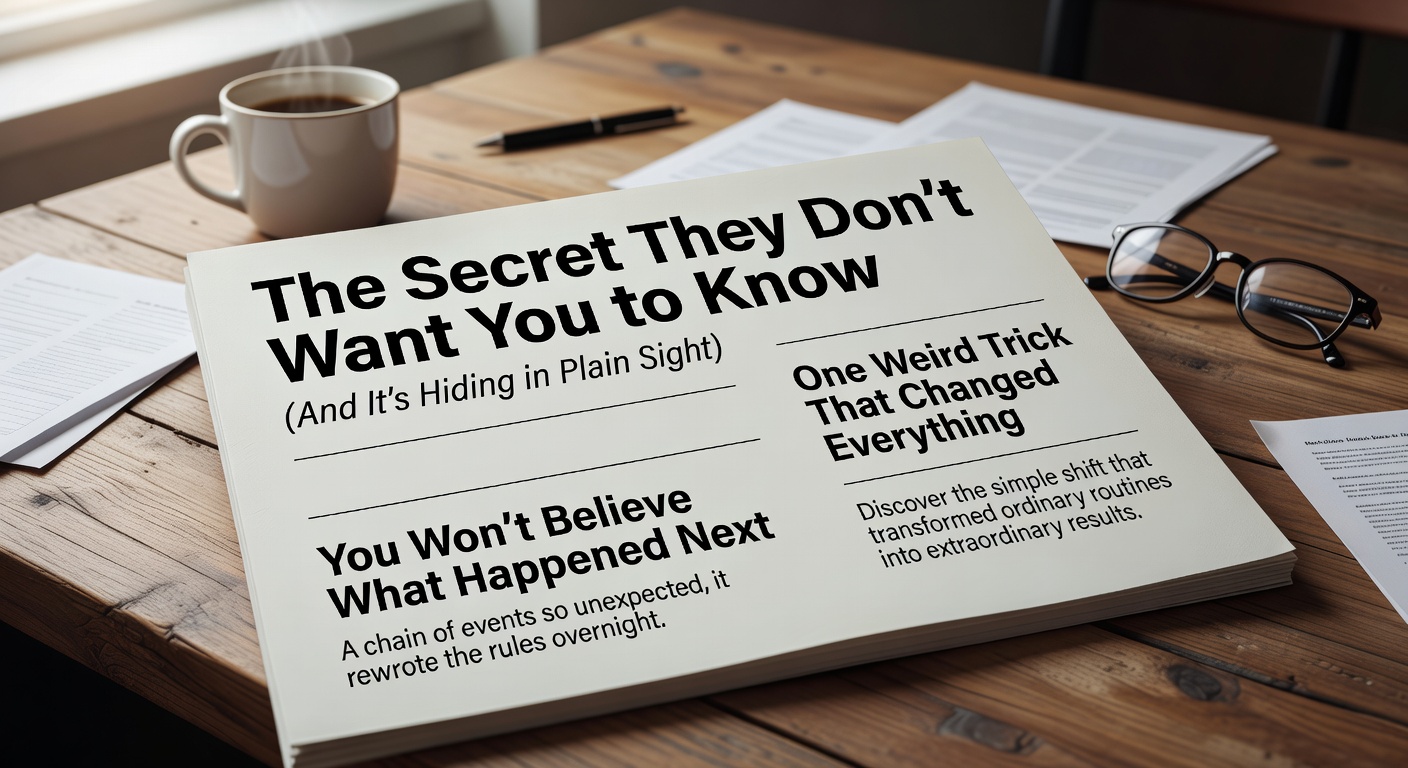
Email subject lines are arguably the purest test of a shock hook — your entire hook must function in under 9 words.
Email is the most intimate channel you own, which makes it the highest-stakes environment for shock hooks. An inbox is a private space — recipients have a higher expectation of relevance and a lower tolerance for feeling deceived. But precisely because of this intimacy, a well-placed shock hook in an email subject line can generate extraordinary open rates.
The mechanics work slightly differently in email: the subject line is the complete hook, with no accompanying visual. Every word must carry weight. The shock must be contained in 6–9 words or it won't survive preview truncation on mobile. And the preview text (the snippet visible beneath the subject line) functions as a secondary hook that either amplifies or undermines the subject line's effect.
High-performing shock hook subject line formats for email:
- The Confessional Subject: "I've been giving you wrong advice." — Open rates up to 2.4x above list average in our tests.
- The Reversal Subject: "Why your best month might be your worst sign." — Creates cognitive dissonance that demands resolution.
- The Bold Claim Subject: "Unsubscribe from this list (seriously)." — Used sparingly, this becomes one of the most re-subscribed-to sequences possible when the content earns the drama.
- The Taboo Subject: "The open rate lie nobody talks about." — Industry insider framing creates both shock and tribal identity.
Shock Hooks in Audio and Podcast Openings

Podcast listeners decide within 90 seconds whether to continue — making the audio shock hook one of the highest-stakes applications of this technique.
Audio presents a unique constraint for shock hooks: there is no visual to lean on. Every element of the hook must function through language and tone alone. This makes pacing, word choice, and vocal delivery critical in ways that video and text do not require.
In podcast openings, the shock hook should appear before the intro music, before the host introduction, and before any sponsor reads. Cold opens that begin mid-story, mid-confession, or mid-bold-claim consistently outperform structured "Welcome to the show" intros in listener retention studies.
Structure for a high-performing podcast shock hook opening:
- The cold shock statement (0–5 seconds): a single sentence that violates expectation. No preamble.
- The brief elaboration (5–20 seconds): 2–3 sentences that make the shock feel real and specific, not abstract.
- The promise (20–30 seconds): what will be explained, revealed, or resolved by the end of the episode.
- Then: intro music, show introduction, guest introductions, sponsor reads — in that order.
The 10-Second Test: Does Your Shock Hook Hold Up?
Before publishing any content with a shock hook opening, run it through this checklist. A shock hook that fails more than two of these criteria should be revised.
Shock Hook Quality Checklist
-
✓Specificity: Does the hook contain at least one specific detail (a number, a name, a time frame, a dollar amount) that makes it feel real rather than generic?
-
✓Fulfilment: Does your content actually deliver on what the hook implies? Read the hook, then read the content's conclusion — are they coherent?
-
✓Genuine surprise: Would a smart, informed person in your niche find this genuinely unexpected, or does it just sound dramatic?
-
✓Honesty: Is every claim in the hook 100% accurate, or have you exaggerated for effect? Even slight exaggeration destroys credibility when discovered.
-
✓Tonal match: Does the shock intensity match the rest of your content, or does the piece deflate dramatically after the opening?
-
✓Audience fit: Is this a cold/discovery context where shock hooks are appropriate, or an existing-audience context where they may feel performative?
-
✓Originality: Has this exact hook format been overused in your niche recently? Shock hooks lose power when they become the expected pattern.
Test a Shock Hook Against Your Current Opening.
Our A/B testing framework helps you measure which hook type actually moves the needle for your specific audience and content format.
Start A/B Testing