What Is a Curiosity Hook?
Every piece of content competes for the same finite resource: human attention. Curiosity hooks are the most reliable weapon in that competition — not because they trick people, but because they activate one of the most fundamental drives in human psychology.
A curiosity hook is any opening that creates a deliberate gap between what the audience currently knows and what they want to know. It isn't just a vague tease. It's a precisely engineered information asymmetry that makes continuing to watch, read, or listen feel psychologically necessary.
The academic foundation for this comes from Carnegie Mellon economist George Loewenstein, whose 1994 paper "The Psychology of Curiosity" introduced the information gap theory. Loewenstein proposed that curiosity arises when we become aware of a gap in our knowledge — and that gap creates a sensation akin to an itch that demands to be scratched. The more specifically defined the gap, the stronger the itch.
"Curiosity is aversive and will commonly be referred to as a 'drive,' like hunger or thirst." — George Loewenstein, 1994
For content creators, this is extraordinarily useful. You don't need to deliver extraordinary information. You need to make people feel that they are missing something specific — and that the answer is just moments away.
Why Curiosity Is the Most Powerful Hook Type
Curiosity hooks outperform other hook types across nearly every platform and format. Here's why: they trigger the brain's dopamine reward loop before any reward has been delivered.
When you encounter information that suggests a gap — "here's what most creators get wrong about hooks" — your brain immediately begins predicting the answer. That prediction process releases dopamine, the same neurotransmitter associated with pleasure, motivation, and compulsive behaviour. You experience a small hit of reward simply from anticipating the information, which makes consuming the content feel urgent rather than optional.
This is fundamentally different from how other hook types work. A shock hook interrupts attention. A story hook builds emotional investment. But a curiosity hook creates a physiological drive state — a genuine need to resolve the open loop your brain has just created. Stopping mid-content feels genuinely uncomfortable when a curiosity hook has been well-constructed.
Platform algorithms reinforce this further. High watch time, completion rates, and scroll depth — the metrics that determine algorithmic distribution on TikTok, YouTube, Instagram Reels, and LinkedIn — all correlate strongly with content that uses curiosity hooks. The brain's compulsion to close information gaps keeps viewers watching, which signals quality to the algorithm, which distributes the content to more viewers. The loop compounds.
The Dopamine Loop in Three Steps
1. Gap Detection — You notice that something you don't know matters. 2. Anticipatory Dopamine — Your brain releases dopamine in anticipation of the answer. 3. Resolution Drive — Consuming the content feels psychologically necessary, not optional.
The 7 Patterns of Curiosity Hooks
Curiosity hooks are not a monolithic category. After analysing 3,000+ hooks across formats and platforms, we've identified 7 distinct patterns, each exploiting the information gap in a slightly different way. Knowing which pattern to use — and when — is the difference between a hook that performs and one that falls flat.
The Partial Reveal
You hint at something remarkable you've discovered, but withhold the specifics until the audience is already engaged. The key is that the partial information must be specific enough to feel real, not generic.
The Numbered Secret
Numbers create a concrete, bounded information gap. The audience now knows there is a specific quantity of things they don't know, which makes the gap feel completable — and therefore compelling.
The Contradicted Belief
You open by asserting that a commonly held belief is wrong. This creates a gap between the audience's existing model of reality and the new information you're implying exists. The cognitive dissonance demands resolution.
The Buried Lead
You reveal that the most important piece of information is coming — but not yet. The promise of a payoff at the end is powerful because it transforms the entire piece into one long resolution of a curiosity gap.
The Identity Puzzle
You present a binary or spectrum that invites the audience to self-classify. The gap here is self-knowledge — which type am I? — which is one of the most compelling categories of information we seek.
The Data Tease
A specific statistic that implies a gap between where most people are and where the few successful ones are. The specificity of the number matters — "94%" feels real, "most" feels vague.
The Before/After Gap
You establish a dramatic contrast between a previous state and a current one, without yet explaining the mechanism of change. The gap is the missing middle — what happened between those two points?
Platform-by-Platform Curiosity Hook Examples
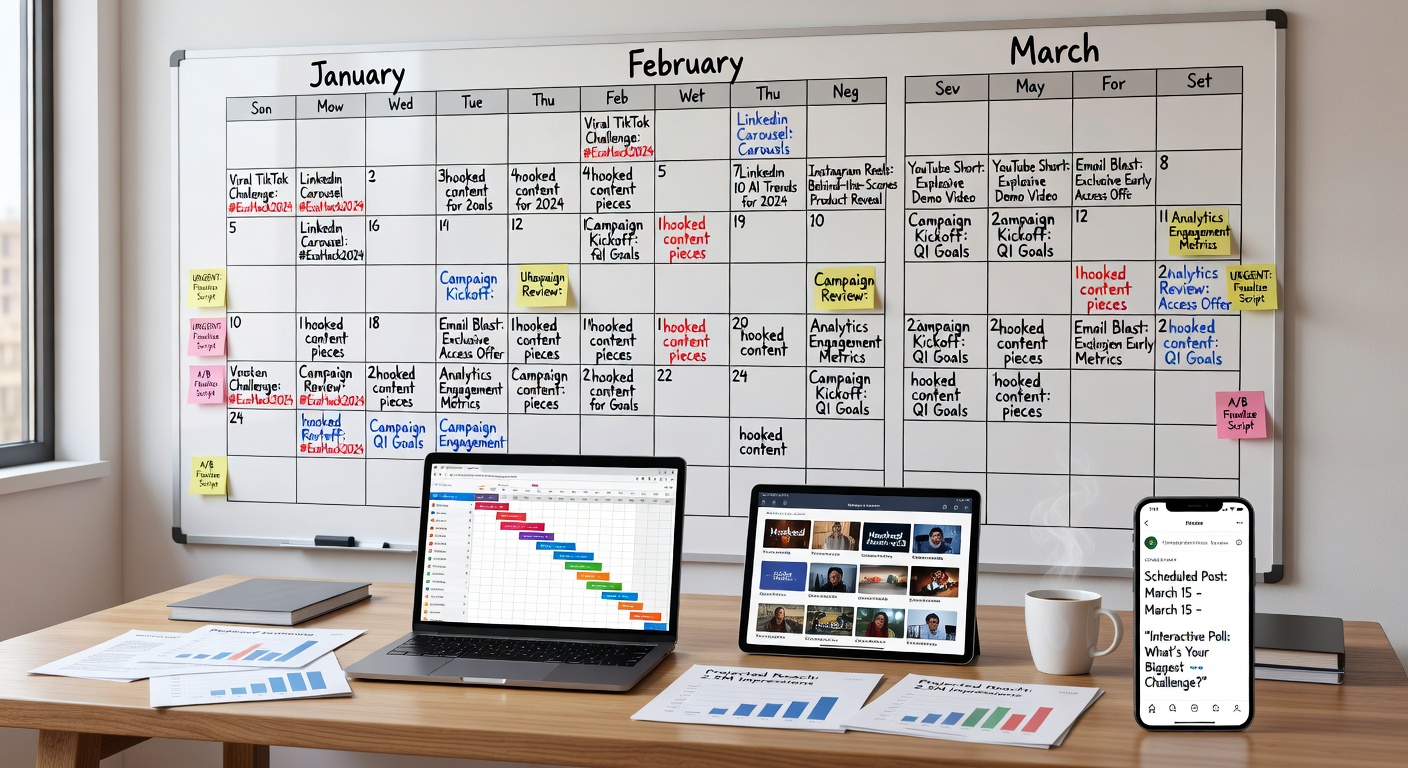
Strategic sequencing of curiosity hooks across platforms requires planning — what you reveal on one channel can seed curiosity on another.
The same pattern can be expressed very differently depending on the platform's format constraints, audience expectations, and content culture. Here's how the Partial Reveal pattern — arguably the most versatile — plays across the major platforms:
| Platform | Format Constraint | Curiosity Hook Example | Key Mechanic |
|---|---|---|---|
| TikTok | First 1–3 seconds visual + audio | "The one thing nobody tells you about going viral — I'm going to show you in 60 seconds." | Auditory gap + time scarcity creates urgency |
| YouTube | Title + Thumbnail + first 30 seconds | Title: "I Tested 50 Hook Formulas. Here's the Only One That Worked." | Thumbnail: frustrated face + "50 TESTS" | Visual + textual gap before video even starts |
| Instagram Reels | On-screen text overlay, first frame | Static frame text: "POV: You just found out you've been opening your content all wrong." | Identity + implied gap creates defensive curiosity |
| "See more" truncation after line 2 | "Last week I lost a client worth ¥2 million. Here's what I learned (and why I'm glad it happened):" | Truncation forces click to close the emotional and informational gap |
Notice that in each case, the platform format itself becomes part of the hook mechanism. On LinkedIn, the algorithm-imposed "See more" truncation is the creator's best friend — it turns any sufficiently intriguing first two lines into a curiosity hook by design.
Testing Your Curiosity Hooks: What to Measure

Testing hooks systematically requires tracking the right metrics at the right time in the content lifecycle.
Curiosity hooks are unusually testable because their primary function — getting someone to continue watching, reading, or clicking — maps directly onto measurable platform metrics. Here's what to track:
- 3-Second Retention Rate (Video) — This is the proportion of viewers who watch past the 3-second mark. A strong curiosity hook should push this above 80%. If you're below 60%, the gap isn't compelling enough or the delivery is too slow.
- Average View Duration / Watch Time — Curiosity hooks set a promise. If your AVD drops sharply after a strong 3-second retention, the content is failing to fulfil the promise made by the hook. Both halves of the equation must deliver.
- Click-Through Rate (For thumbnail/headline hooks) — On YouTube and blog platforms, a curiosity hook embedded in the title should move CTR above platform average (typically 4–8% on YouTube). Anything above 8% signals a strong gap.
- Completion Rate — For longer content, the buried lead pattern specifically is designed to maximise this metric. Track completion rate before and after adding a "payoff promise" to your intro.
- Comment Sentiment — Curiosity hooks done well generate comments like "This is exactly what I needed" or "How did I not know this?" Curiosity hooks done poorly generate "Clickbait" or silence. Monitor qualitative signals alongside quantitative ones.
- A/B Test Velocity — Don't test one hook against one alternative. Test 3–5 variants simultaneously when the platform allows. On LinkedIn, publish the same content with different opening lines across multiple accounts or in different weeks. Cycle fast.
When NOT to Use Curiosity Hooks

Curiosity hooks belong at the top of the funnel. Lower in the funnel, they can feel manipulative — and that's a reputation cost you cannot afford.
The information gap is a potent psychological lever, and like all potent tools, misuse has consequences. Here are the contexts where curiosity hooks actively harm your content performance:
When you can't deliver on the promise. If your curiosity hook implies a revelation that the actual content doesn't provide, you have not built suspense — you have manufactured disappointment. Disappointed audiences don't just leave. They leave with a negative emotional association with your brand that persists long after the scroll.
When your audience is already past the awareness stage. Curiosity hooks are top-of-funnel mechanisms. If you're emailing a warm list of existing clients with a transactional update, opening with a coy information gap reads as manipulative and infantilising. Match the hook to the funnel stage.
When the topic requires immediate trust. In healthcare, legal, financial, and crisis communication contexts, withholding information — even temporarily — signals untrustworthiness. These audiences need authority hooks (lead with credentials and clear facts) rather than curiosity hooks.
When you use them on every single post. Curiosity hooks work in part because they stand out from patterns. If 100% of your content uses the same gap-and-tease structure, audiences become desensitised and begin predicting — and resisting — the mechanism. Vary your hook types deliberately and treat curiosity hooks as a frequent but not universal tool.
The Ethical Test for Any Curiosity Hook
Ask yourself: "If someone consumes this content fully, will they feel the gap I created was genuinely filled?" If yes, publish. If no, rewrite the hook to make a promise your content can actually keep.
Ready to Write Curiosity Hooks That Convert?
Use our ready-made templates — 200+ hooks across every format and platform, built around the 7 patterns above.
Browse Hook Templates